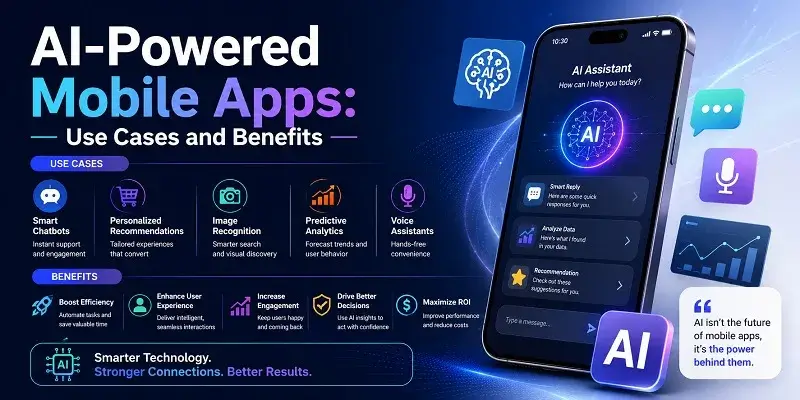
The advancement of mobile applications has exceeded basic uses for communication and entertainment into a world of digital advancements achieved via technology and mobile apps. The greatest contributor to this change is the advent of AI-Powered Mobile Apps that provide passive user interaction with technology.
AI is creating a new way for mobile apps to operate intelligently, reactively, and user-focused through the use of personalized recommendations and real-time decision-making. As users’ expectations increase, so too does the number of companies incorporating the use of AI in order to be competitive and provide remarkable experiences to their customers.
What Are AI-Powered Mobile Apps?
AI-Powered Mobile Apps are mobile applications that incorporate AI technologies, including ML, NLP, and CV, to accomplish tasks that would otherwise require human intelligence to complete. AI apps can use ML to analyze data and learn from how users interact with them, allowing them to constantly enhance their capabilities over time.
Unlike conventional applications, AI-powered applications continue to evolve as they are utilized, making them extremely flexible and efficient. Everything from a chatbot that understands user queries to a recommendation engine that recommends items can utilize AI to develop new ways of creating applications based on user interaction; AI is at the heart of innovation in today’s apps.
Key Use Cases of AI-Powered Mobile Apps
The use of AI-Powered Mobile Apps is redefining the value businesses deliver to their customers by providing smarter, faster, and more personalized experiences for their users through real-time insights, automation, and more. The usage of AI-Powered Mobile Apps spans across all industries to solve difficult problems and improve operational efficiency, so we will discuss some of the most common use cases leading this evolution.
1. Personalisations of User Experience
The personalization of users’ experience, using AI-powered mobile apps, has been one of their most impactful applications. AI algorithms will analyze a user’s behavior, preferences, and interactions to create customized content and/or provide recommendations.
For example, streaming apps make recommendations on content based on a user’s historical watching behaviour, whereas eCommerce apps will recommend products based on browsing behaviour. The positive effect of this level of personalization has a major impact on both site user satisfaction and retention.
2. Virtual Assistants and AI Chatbots
Typically, AI-Powered Mobile Apps include Virtual Assistant and AI Chatbot-like capabilities, as they provide users with instant support for customer service.
Examples of what these AI Chatbots and Virtual Assistants can do include the following:
- Instantly answer customers’ questions
- Simultaneously handle multiple customer conversations
- If necessary, learn to improve the AI chatbots’ and Virtual Assistants’ overall response to customers
By having AI Chatbots and Virtual Assistants available for assistance, businesses are able to reduce the number of personnel required to provide customer support and provide customers with quick and accurate assistance.
3. Recognition and word processing of audio
Voice-enabled features continue gaining traction within AI-powered mobile applications. With the ability to include natural language processing, voice commands are now being understood and acted upon efficiently by the application.
Notably, anything users can perform using text-based commands can now also be done with voice (i.e., searching for, sending a message, or turning on/off a device).
4. Recognition and processing of images and facial data
Computer vision is yet another robust feature present in AI-powered mobile applications. This function enables mobile applications to evaluate an image by analyzing its contents and determining if the content includes any particular pattern, object, or facial structure.
Some common usages include:
- Unlocking a mobile device via face recognition
- Image search capabilities
- Augmented reality capabilities
These functions significantly enhance the capabilities of the application while also increasing its usability.
5. Use of Predictive Analytics
AI-Powered Mobile Applications provide businesses with the ability to use predictive analytics capabilities to determine in advance what the end-user may want/need based on information collected during previous contact with the user.
Examples include:
- Fitness applications offering workout plans
- Financial institutions offering insight into past spending activity
- Retailers providing insight into users’ expected purchases
The use of predictive analytics capabilities enables businesses to provide value-added benefits to the end-user.
6. Fraud detection and security
Security is an important issue for mobile application development, and the development of AI-Powered Mobile Apps will help resolve this significant issue.
AI technologies provide the ability to detect unexpected activity as well as provide users with assistance in determining possible threats in real time. This is particularly useful within Banking and Financial Apps, where the necessity of user activity verification has been very high.
In addition to increasing overall security through continuous monitoring of user activities, AI increases user trust.
7. Recommendation Engines
Recommendation engines have been one of the most widely adopted AI features in AI-powered mobile apps. Recommendation systems leverage user data to provide appropriate products, services, or content to users.
Many platforms, such as Shopping Apps, music streaming services, and social platforms, are dependent upon recommendation engines to not only maintain user engagement rates but also increase conversion rates.
Benefits of AI-Powered Mobile Apps
The rise of AI-Powered Mobile Apps has been driven heavily by the many benefits these types of apps bring to both businesses and users. AI-Powered Mobile Apps not only enhance the functions themselves but also provide a way for both users and businesses to maximize their efficiency and engagement and, ultimately, make informed decisions. Below, we will review the key benefits of AI-Powered Mobile Apps in more detail.
1. Exceptional User Experience
The greatest benefit of using AI-Powered Mobile Apps is being able to provide users with more personalized, seamless experiences. These types of applications are able to learn about the behavior of users and serve them with relevant content and feature offerings, making the users’ experiences more engaging.
2. Increased Automation and Efficiency
AI is now automating much of the repetitive work businesses do on a daily basis, increasing the level of efficiency businesses can achieve. AI-Powered Mobile Apps are capable of providing solutions to reduce the manual efforts that would typically produce underwhelming results for all aspects of business, from support to reporting and data analysis.
3. Enhanced Decision Making
By providing businesses with real-time data and insights, AI-Powered Mobile Apps enable businesses to better and more effectively make decisions, driving much higher levels of performance. AI-Powered Mobile Apps utilize analytics to help identify trends and predict results, as well as assist in optimizing the business’s strategic objectives.
4. Increasing Customer Engagement
Engaging with users through AI-Powered Mobile Apps is critical to the success of any application; AI-Powered Mobile Apps excel at increasing customer engagement. Features such as chatbots, personalized notifications and recommendations, and localized offers create opportunities for users to engage in meaningful ways with the application.
5. Scaling And Flexibility
With growing companies, software must also grow (scale). AI-enabled mobile applications can scale up to perform efficiently when there is an increase in both the number of records being stored and the number of users accessing the application.
6. Competitive Benefits
By adding Artificial Intelligence to your mobile apps, a software development company can gain a large advantage over its competitors. AI-enabled mobile applications provide unique capabilities with enhanced data management for attracting & keeping new users.
Conclusion
In short, Companies today are enhancing their relationships with customers through AI mobile applications to deliver improved, intelligent, faster, and more tailored services. AI mobile apps have become one of the cornerstones of digital transformation, as they enhance client engagement as well as provide organizations with the ability to make data-based decisions.
As AI keeps growing and evolving, so do the potential markets for AI mobile apps; therefore, investing in AI mobile apps is very important for any organization that is interested in remaining competitive both now and in the future.
Organizations that partner with an experienced mobile app development company will be able to take ideas that may be existing only as innovative ideas and turn them into useful applications that both provide true benefit to their users and create business models that will support ongoing growth over time.