
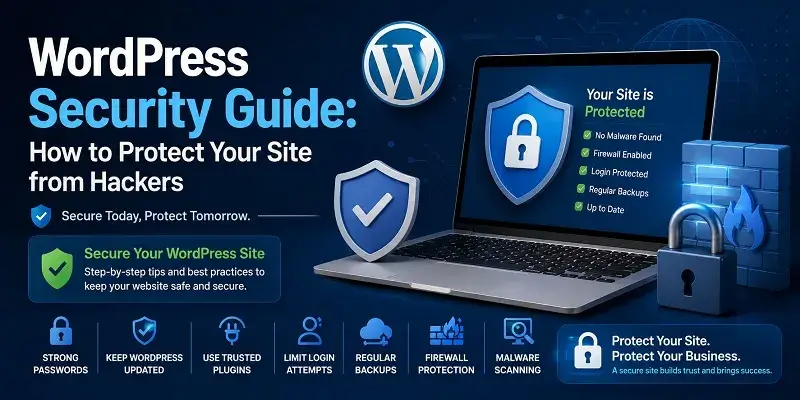
The WordPress website you are developing needs to implement the right website security. Not only are hacking techniques becoming more advanced, it is essential that everyone learn techniques to protect sites from being hacked. You have to take preventative measures so that you don’t become an easy victim.
Many newcomers believe that security is best for large websites, however, smaller websites can also be targeted. A security breach can lead to missing data, loss of popularity, and reduced visitor consideration. The exact news is that you do not need advanced technical talents to protect your website.
This entire guide explains effective steps to stabilize your WordPress website. After going agreeably through the earlier steps, you are left comforted that you mitigated many potential negative effects for your information and your online world overall.
Reasons and Importance of WordPress Security
Safeguarding Sensitive Information
WordPress websites constantly contain important information, such as the organization’s username, passwords, and commercial company data. If there is no secure method employed, the file will become susceptible to any form of hacking attempts by individuals who may seek to exploit it. Insecure websites result in the loss of data, financial loss, and personal information being misused.
Build up your website’s reputation
Your reputation and traffic may suffer if your website has been hacked at some point. Visitors expect websites to operate smoothly, particularly when exchanging sensitive information. If your website is compromised, traffic may fail to return and your emblem may be lost. Maintaining strong security helps build credibility and ensures quality enjoyment among your target audience.
Prevention of downtime and loss of traffic
Security problems can cause your website to go offline or symptoms to go inappropriately. Downtime does not affect handiest individuals revel however also leads to loss of visitors and potential revenue. Search engines can lower your ranking even if your website is regularly unavailable. Strong maintenance practices help prevent such problems and keep your website running easily.
Common WordPress Security Threats
Malware and Virus Attacks
Another major threat to WordPress websites is malware. It refers to any kind of malicious software that may harm your site by either causing damages to your files or stealing valuable information. Brute force attacks usually happen when hackers launch malware on your site in an attempt to hijack the website.
SQL Injection Attacks
SQL injection occurs when attackers insert malicious code into your website’s database. This gives them access to obtain or control access to tactile statistics. Hackers use security weaknesses which arise from outdated software and badly written plugins. Your website requires ongoing updates to maintain security against potential attacks.
Brute Force Attacks
A brute force attack is one where the hacker attempts to log into your website through different password and username combinations until they manage to enter your website. The danger of this kind of attack is heightened because many people have weak passwords.
Cross Site Scripting (XSS).
XSS attacks involve injecting dangerous scripts into your website that can affect traffic. These scripts can borrow user data or redirect users to malicious sites. Proper input detection and security features can help protect against this threat.
Outdated Themes and Plugins
Using old languages and plugins is the main security risk. Have updates available that can overcome security vulnerabilities, failing to update these could leave your website vulnerable to attacks. Your browser needs regular replacement updates to maintain its security.
WordPress Security Guide: How to Secure Your Website Against Hacking
Implement robust login credentials
The first step to secure your WordPress website is to use a strong get entry on credentials. Avoid using non-standard names that include “admin” and consistently use a set of letters, numbers, and single characters in your passwords. Simple passwords are easy prey for attackers. You can even employ the services of a password manager.
Update WordPress, Problems, and Plugins
It is an essential element of keeping websites up-to-date. Developers deploy routine updates to create bugs and vulnerabilities within security. If you don’t keep up with updates, your website is widely open to attacks. Your online website should generally be kept up to date, primarily middleware, themes, and plugins, to ensure that it remains contained against new vulnerabilities.
Install a reliable security plugin
Security plugins provide monitoring capabilities for your site along with security against any threat. Some of the services offered by such plugins include malware scanning and firewall security. These gears can detect malicious interest and intercept skill attacks before they serve a damaging purpose. Choosing a reliable security plugin provides another layer of security for your website.
Allow Two Factor Authentication
In order to ensure that you are who you say you are when logging in, we have included an additional security measure to the login procedure. With this new measure in place, it will be extremely difficult for any unauthorized user to access your account, even if by chance he knows your password.
Use SSL and Secure Hosting
SSL certificates encrypt data shared between your website and clients. This protects sensitive records that contain login credentials and personal information. In addition, the decision of a static web hosting provider ensures better security of the server platform from threats. A good hosting provider ensures security tools within its packages for your web security.
Limit Access Attempts and Observe Activity
Restriction of access attempts helps avoid a brute force attack on the website. Once the attempt reaches a specified number, accessing is impossible; therefore, passwords cannot be claimed. Monitoring the activity of the site helps detect problems at an earlier stage, when damage can still be prevented.
Perform Backups Regularly
Backups are essential in case of any attack on your site. With the help of a simple backup, you could easily tackle your website without losing out content. Keep the backup in a safe place and don’t forget to continuously make changes as desired.
Advanced Security Tips
Use a Web Application Firewall (WAF)
A web application firewall acts as a defense between your website visitors and visitors. Filters and blocks malicious requests before they reach your server. This prevents attacks such as SQL injection, cross-website online scripting, and brute pressure testing. A WAF adds an extra layer of security and is noticeable for websites with high traffic or touching statistics.
Turn off file processing in WordPress
However, WordPress enables you to sign up through the dashboard by default. The instability here lies in that the attacker can use his profits to access your site if he gains access to your account. By switching off this feature, you ensure that no one posts important documents and topics on your site without your permission.
Use secure file permissions
Setting rights to directory permissions ensures that the simplest authorization clients can obtain and regulate access rights to rights on files. Your website security becomes vulnerable through the use of incorrect permissions. The organization needs to implement access restrictions for its vital documents and folders to prevent unauthorized access. This clean post strengthens the fundamental security of your website.
Restrict access by hiding the login page
The modification of the login URL default helps to make it more difficult for hackers to identify your login browser. The additional step of security is that it restricts access only to specific IP addresses.
Keep an eye on the website and scan it regularly
Regularly monitoring games makes it easier for us to detect unauthorized users who intrude on our premises without permission. Security tools allow you to test your website for every malware and security weakness. Your internet site will maintain its responsiveness through a relentless game of monitoring.
Common security vulnerabilities to avoid
Using Weak Passwords and Default Usernames
A common mistake is using easy passwords or default usernames like “admin”. These are smooth targets for brutal pressure attacks. Use unique credentials to protect your site from hacking attempts.
Website upkeep neglect
Website owners neglect to update the core WordPress installation to themes and plugins. Software running your website may have vulnerabilities that are known to hackers. Updates are a lesson in ‘do or die’.
Backups are NOT optional
My site can’t be hacked if I don’t back it up. It may seem that way, but the lack of proper backup files drastically alters the recovery versus loss, chaos algorithms. Make your backup situation the least difficult. When in doubt, back it up. Keep a backup, and, in the words of ‘The Most’, a fresh backup.
Adding awesome Plugins and Themes
It would be best to download plugins and themes only from credible websites. The files downloaded from dubious websites may contain malware. It is also necessary to avoid pirate themes and outdated files.
Lack of safety monitoring
Often, threats can be removed without tracking your website. Hackers also benefit from gaining privileged access privileges and remaining unprotected for a long time. Regular observational US and scans can help detect problems early and prevent serious injury.
Benefits of Strong WordPress Security
Security of Sensitive Data
Strong WordPress security helps protect important records that include user data, passwords, and company information. Hackers often scour to borrow this file for malicious work targeting websites. You can prevent unauthorized access by using the right security features like encryption, firewall, and static access. This ensures that every file you have and your clients’ files are always protected.
Website trust and credibility improved
A static website is popular among visitors. Users are much more likely to interact with a website whose experience is safe. The use of SSL certificates and reliable payment systems indicates that your website is legitimate. If your website is credible, there will be an increased probability of returning visits, submission of data, and transactions, thus making your website more credible.
Lower server failures and cyberattacks
The proper use of cybersecurity measures lowers the possibility of a cyberattack that will cause server failures. This causes low traffic on the website, and the business loses revenues from sales. Your website maintains continuous operational capacity through the implementation of cybersecurity practices.
Better SEO Performance
Search engines prefer static websites and rank them better in search results. HTTPS and other security features and fast performance contribute to a higher search engine market. A static website not handiest protects records but also improves visibility and attracts more natural site visitors.
Peace of Mind for Website Owners
Once your website is nicely contained, you can take note in developing your commercial enterprise as opposed to bothering about security threats. Strong security measures provide confidence that your website is safe from potential threats.
Future Trends in WordPress Security
WordPress security is evolving rapidly with new technologies and smart security systems. A leading trend is the use of artificial intelligence to stumble upon and mechanically defend against your threats. The AI based total tool can monitor visitors to the website in real time and identify abnormal behavior before it turns into a serious problem.
Another essential way is to use good encryption strategies to protect sensitive statistics. This technique ensures a stronger defense against sophisticated cyberattacks. Multiparty authentication is also becoming extra common, with multiple layers of user funds and credit.
Cloud-based security solutions have become popular because they provide websites of all sizes with effective security and scalable performance. The system achieves better security through its continuous automatic updates and its scheduled security patch deployments.
WordPress will take into account security automation, advanced monitoring, and powerful statistical security to keep websites safe.
Conclusion
However, following the proper way to secure your website as described in the eBook titled “WordPress Security Guide: How to Protect Your Website from Hackers” is important if you want to be sure that your website can be stable and reliable. The process of securing your website is not a one-time; It must be constantly updated and improved.
By taking measures that include implementing SSL, security plugins, and backup systems to ensure your passwords are strong, you make your website extra stable and secure from hackers.
With the constant changes and trends in cybersecurity risks, your knowledge of cybersecurity needs to be updated frequently. A secure website no longer keeps your information the easiest, but also complements your recognition.