
Live dealer gaming is quietly one of the most technically demanding consumer streaming use cases in existence. Unlike video-on-demand — where buffering, pre-fetching and adaptive bitrate delivery have essentially solved the latency problem — live casino requires true real-time video delivery where a delay of even a few seconds between the dealer’s action and the user’s screen has direct consequences for gameplay integrity. A card dealt, a roulette wheel spun, a game show outcome revealed: these events must land on the user’s device with latency low enough that the interactive elements of the experience — placing bets, making decisions, reacting to outcomes — remain meaningful rather than theoretical. Platforms like https://max-winindia.com/ — operating 528 live casino titles from providers including Pragmatic Play, Playtech, Ezugi, Amusnet and Iconic 21, and serving Indian users on INR accounts via UPI, PhonePe and PayTM — are running streaming infrastructure at a scale and technical specification that most discussions of India’s digital entertainment market significantly underestimate.
The Latency Problem in Live Gaming
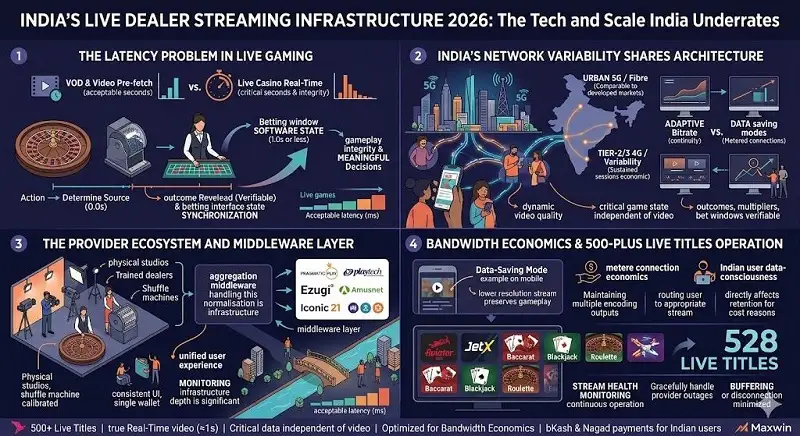
Standard video streaming platforms measure acceptable latency in seconds. A ten-second delay between a live sports event and its appearance on a streaming platform is considered normal. For live casino, that figure needs to be closer to one second or less, and the requirement is not just about user experience — it is about game integrity.
Consider the mechanics: a live roulette wheel completes a spin in roughly fifteen to thirty seconds. If a user’s stream is delayed by five seconds, they may be placing bets on an outcome that has already been determined at the source. The software layer responsible for betting windows — which opens and closes in synchronization with the physical game — must account for this precisely. The engineering challenge is not just delivering low-latency video; it is maintaining synchronization between the video stream, the betting interface state, and the game outcome data pipeline across a user base with highly variable network conditions.
How India’s Network Variability Shapes Streaming Architecture
India’s network infrastructure in 2026 is substantially better than it was five years ago, but it remains variable in ways that matter for real-time streaming. Urban users on 5G or fibre broadband connections experience conditions comparable to developed markets. Users on 4G in Tier-2 cities experience reliable but bandwidth-constrained connections. Users in smaller towns or rural areas may encounter significant variability within a single session.
Live streaming infrastructure built for India cannot assume consistent bandwidth. The standard solution is adaptive bitrate streaming — dynamically adjusting video quality based on available bandwidth — but for live casino, this creates a design tension.
Reducing bitrate preserves continuity but may degrade the visual clarity of the game surface at precisely the moment a user needs to read card values or track a ball on a roulette wheel. The engineering response involves separating the game data layer from the video layer: critical game state information — outcomes, multipliers, bet windows — is transmitted via a low-bandwidth data channel independent of the video stream, ensuring that even if video quality drops, the game mechanics remain precise and verifiable.
The Provider Ecosystem and Studio Infrastructure
Behind every live dealer title is a physical studio operation: cameras, lighting, trained dealers, shuffle machines, roulette wheels calibrated to regulatory standards, and the encoding hardware that digitises the scene and injects it into the delivery pipeline. Running this infrastructure continuously, across multiple simultaneous game tables, is an operational undertaking that the major providers — Pragmatic Play, Playtech, Ezugi — have built into dedicated facilities designed specifically for live game production.
For platforms aggregating live content from multiple providers, the integration challenge is substantial. Each provider operates its own streaming endpoints, authentication protocols, game state APIs and session management logic. A platform offering games from five or more live providers must present a unified user experience — consistent UI, single wallet, unbroken session continuity — over what is technically a collection of distinct streaming services. The middleware layer handling this normalization is infrastructure that most users never think about and notice only when it fails.
Bandwidth Economics and the Indian User
There is a cost dimension to live streaming that shapes product decisions in the Indian market specifically. Live video consumption is bandwidth-intensive, and while mobile data costs in India have fallen dramatically, users remain more data-conscious than their counterparts in markets where unlimited data plans are the universal norm.
Platforms addressing this have introduced data-saving modes for live games — lower resolution streams that preserve gameplay integrity while reducing data consumption for users on metered connections. The implementation requires maintaining multiple encoding outputs simultaneously and routing users to the appropriate stream based on their device settings or explicit preference. It is a small feature from the user’s perspective and a non-trivial engineering task from the platform’s perspective — the kind of localization work that does not appear in feature lists but directly affects retention among users who would otherwise avoid live games on mobile for cost reasons.
What 500-Plus Live Titles Actually Means Operationally
Maxwin’s live casino section, spanning over 500 games across roulette, blackjack, baccarat, game shows and quick game formats, represents an aggregation of streaming feeds that runs continuously. Every title in that catalogue is a live stream that exists whether or not any particular user is watching it. Managing that infrastructure — monitoring stream health, handling provider outages gracefully, ensuring that users attempting to join a game do not encounter buffering or disconnection — is an ongoing operational task, not a one-time technical build. In 2026, the platforms doing this reliably at scale for Indian users are demonstrating a depth of technical investment that is easy to take for granted and genuinely difficult to replicate.